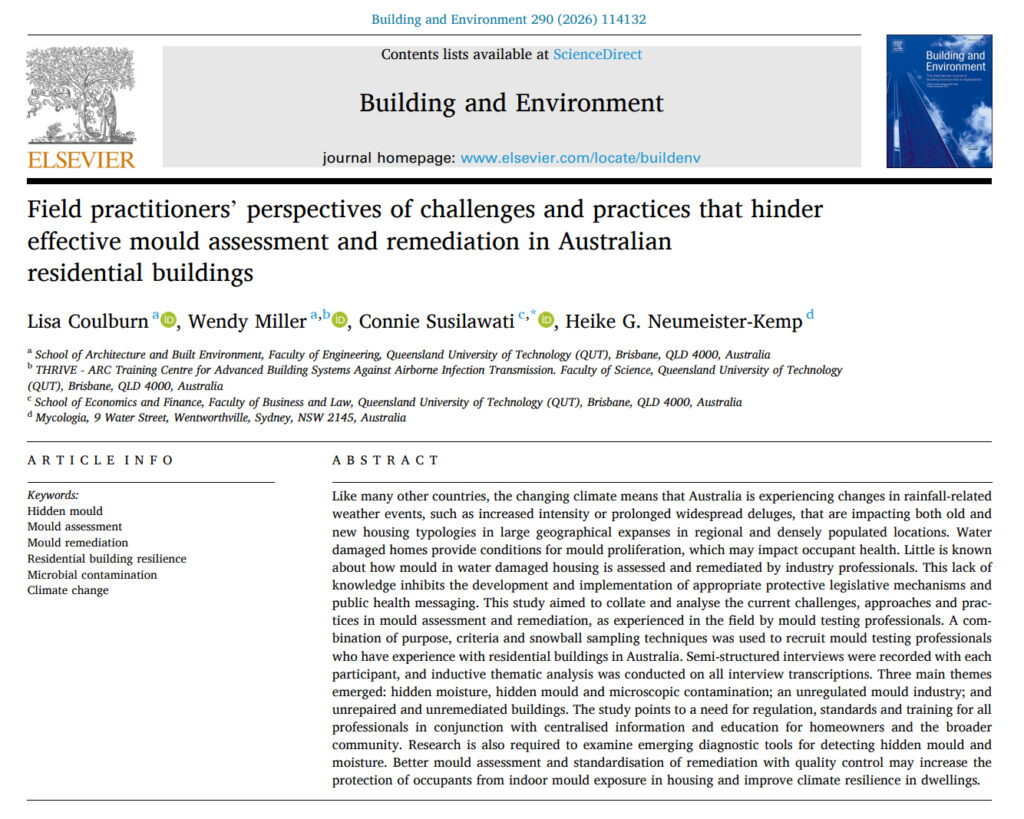
A new paper recently published in Building and Environment by members of the team, titled “Field practitioners’ perspectives of challenges and practices that hinder effective mould assessment and remediation in Australian residential buildings”.
This study aimed to collate and analyse the current challenges, approaches and practices in mould assessment and remediation, as experienced in the field by mould testing professionals in Australia.
Paper highlights:
👉 Hidden moisture, hidden mould and microscopic contamination.
👉 Hard-to-see mould, hidden mould or moisture was a common problem in dwellings.
👉 Poor quality mould assessment, repairs and mould remediation practices occur.
👉 A lack of scientific education regarding moisture and mould occurs in industry.
👉 Government regulations and standards are needed to improve mould industry practices.
👉 Centralised information for homeowners and the broader community is needed.
🔗 Read the paper: https://doi.org/10.1016/j.buildenv.2025.114132
Lisa Coulburn, Wendy Miller, Connie Susilawati, Dr. Heike Neumeister-Kemp, Lidia Morawska, QUT (Queensland University of Technology), Australian Research Council (ARC)