🚨New paper published by members of our team including our partners at The University of Melbourne: Dr Xiangdong Li, Dr Kevin Kevin, and Prof Jason Monty; as well as our Centre Director D/Prof Lidia Morawska.
This paper titled, “Directional Effects of Human and Door Motions on the Transport of Aerosols Across a Doorway” is published in Indoor Air.
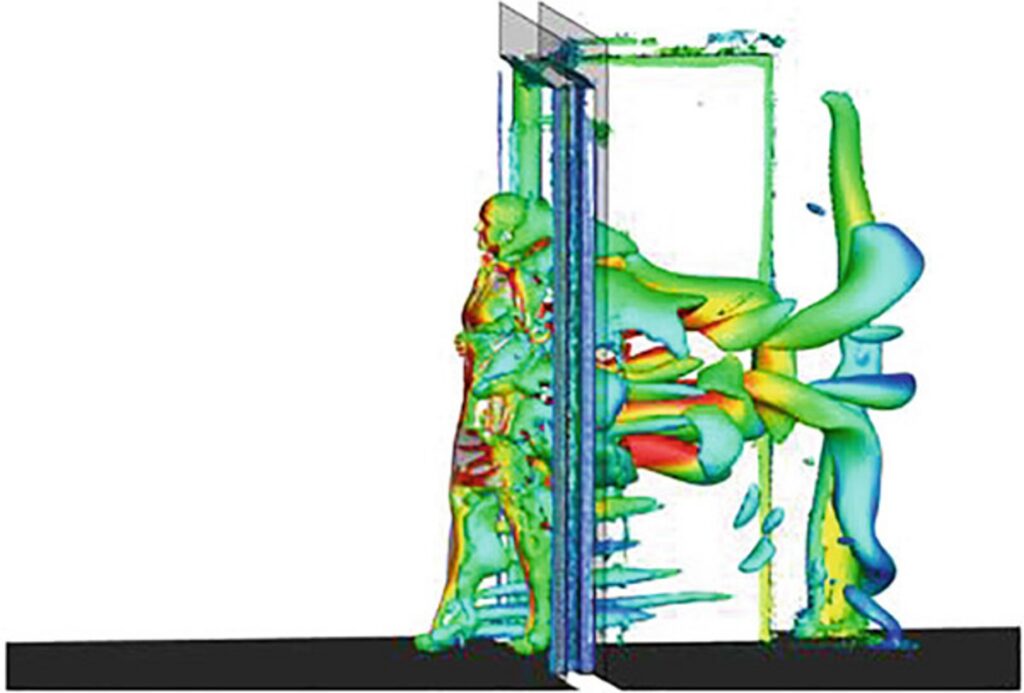
Human movement across a doorway and associated door opening and closing motions is an important mechanism of containment failure in protective rooms. Detailed information regarding the 3D, time-dependent air flow field and aerosol concentration field induced by the motions is of pivotal importance for the development of effective intervention strategies.
This study used boundary-conformal moving mesh techniques to simulate air and aerosol transport from a contaminated room into a pressure-equilibrium clean room. The simulations were conducted with different directions of manikin movement and door swinging in order to analyze their individual and combined effects on aerosol transport.
The study revealed that the vortex flows in the wake regions played a key role in aerosol transport, therefore proposing that destroying the wake flow regions of out-moving objects may be an effective method to mitigate containment failure induced by swinging doors and moving human occupants.
👉 Read the paper here: https://doi.org/10.1155/ina/8863692
Australian Research Council (ARC), QUT (Queensland University of Technology)