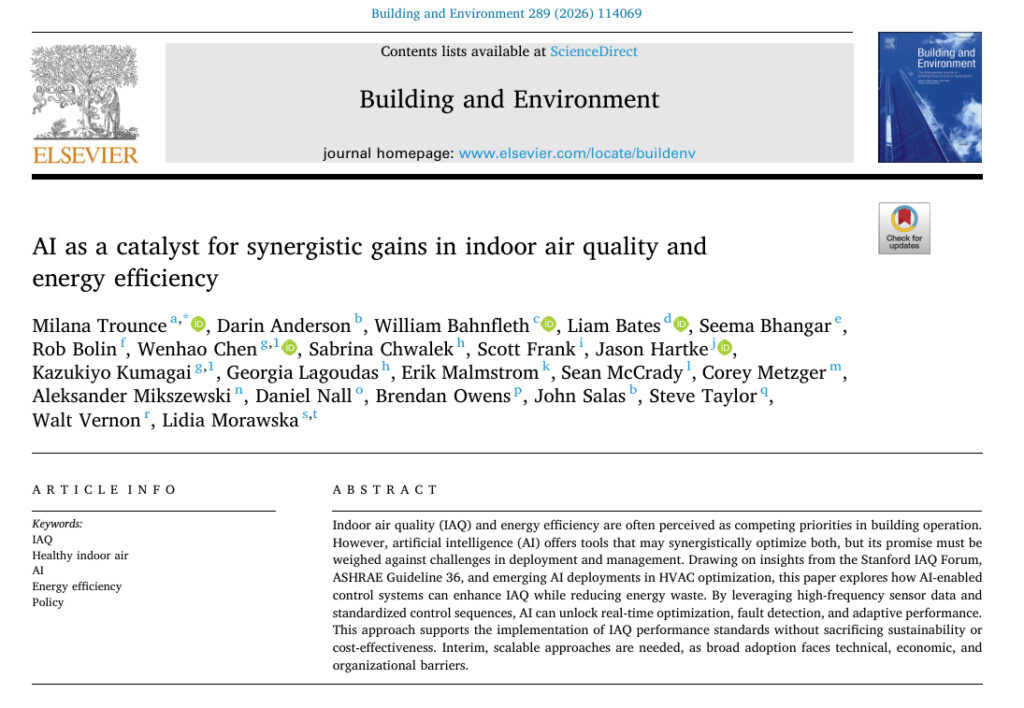
🚨 A new paper recently published in Building and Environment by members of the team, titled “AI as a catalyst for synergistic gains in indoor air quality and energy efficiency”.
Drawing on insights from the Stanford IAQ Forum, ASHRAE Guideline 36, and emerging AI deployments in HVAC optimization, this paper explores how AI-enabled control systems can enhance IAQ while reducing energy waste. By leveraging high-frequency sensor data and standardized control sequences, AI can unlock real-time optimization, fault detection, and adaptive performance. This approach supports the implementation of IAQ performance standards without sacrificing sustainability or cost-effectiveness. Interim, scalable approaches are needed, as broad adoption faces technical, economic, and organizational barriers.
🔗 Read the paper: https://doi.org/10.1016/j.buildenv.2025.114069
Lidia Morawska, Milana Boukhman Trounce, MD MBA, Australian Research Council (ARC), Stanford University, QUT (Queensland University of Technology).