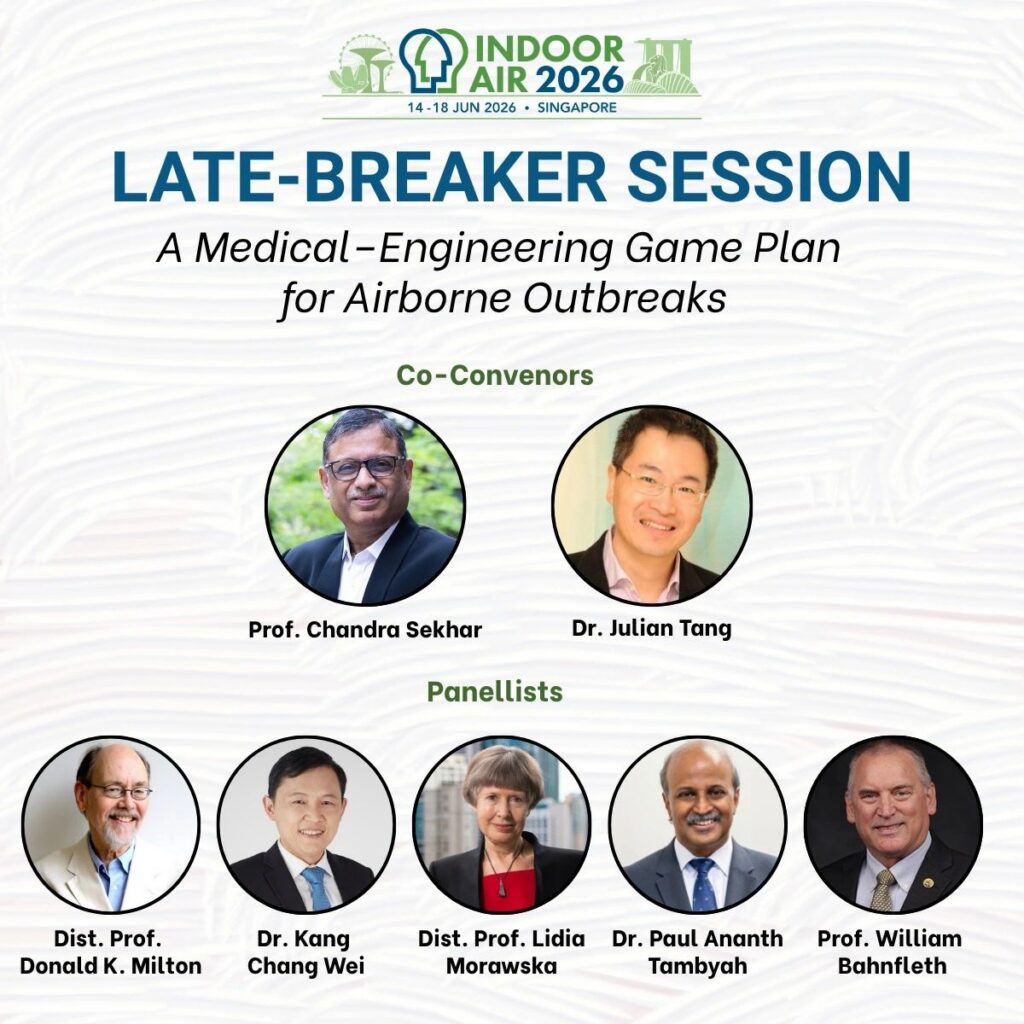
This timely and highly relevant session brings together leading voices from medicine, engineering, and public health to explore how we can better prepare for and mitigate airborne outbreaks in confined, high-occupancy environments.
Co-convened by Dr Julian Tang and Prof Chandra Sekhar, the session will feature an esteemed panel including D/Prof Don Milton, D/Prof Lidia Morawska, Dr Paul Ananth Tambyah, Dr Chang Wei KANG, and Prof William Bahnfleth.
Using the recent cruise-ship Hantavirus incident as a starting point – while looking far beyond a single case study – the discussion will examine practical and scalable engineering interventions for reducing airborne transmission risks across spaces such as hospitals, schools, offices, aircraft, cruise ships, and places of worship.
Key themes include:
👉 Ventilation optimisation and outdoor-air strategies.
👉 Airflow management and infrastructure measures.
👉 Cost-effectiveness and implementation challenges.
👉 Engineering-led outbreak investigations and research approaches.
👉 Bridging medical and engineering perspectives for future preparedness.
This session aims to spark deeper interdisciplinary collaboration and meaningful discussion on how engineering solutions can strengthen resilience against future airborne health threats.
For more information abut the Indoor Air 2026 Conference: https://www.indoorair2026.org/